When Fermentation Goes Wrong: The Hidden Dangers Lurking Inside High-APY Liquidity Pools
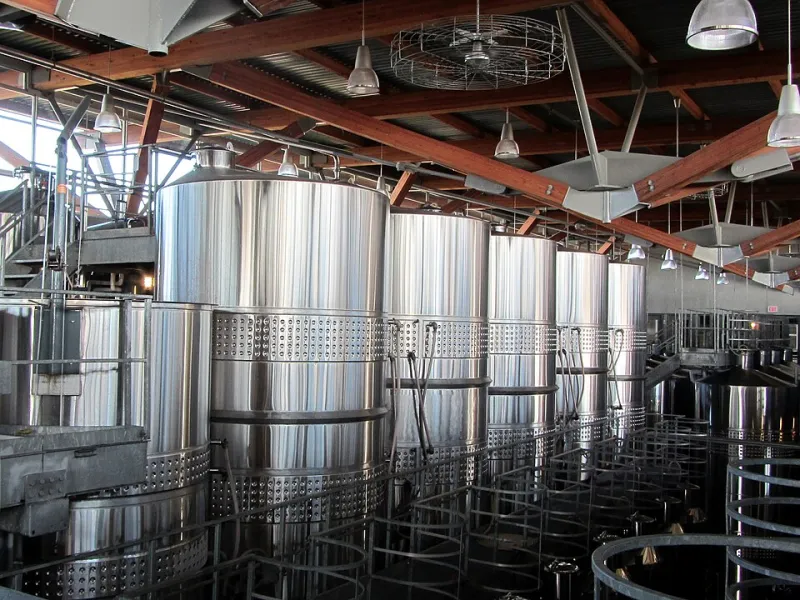
Photo: Loozrboy from Toronto, Canada, CC BY-SA 2.0, via Wikimedia Commons
There is a moment in winemaking when a fermentation vat can go one of two ways. Under the right conditions — controlled temperature, healthy yeast cultures, careful monitoring — the process transforms raw juice into something of genuine complexity and value. Under the wrong conditions, those same biological processes produce acetic acid. The wine becomes vinegar: technically a fermented product, but utterly worthless for the purpose it was meant to serve.
Yield farming in decentralized finance operates on a remarkably similar knife's edge. The mechanics are different, the timelines are compressed, and the marketing is considerably louder — but the underlying dynamic is identical. A process that appears to generate extraordinary value can, with startling speed, produce nothing but a sour residue and a depleted wallet.
This is an opinion-driven examination of why astronomical APY figures in liquidity pools deserve skepticism rather than excitement, and why the discipline required to evaluate a yield farm is closer to enology than it is to gambling.
Understanding the Fermentation Process: How Yield Farms Actually Work
Before diagnosing what goes wrong, it is worth establishing a clear picture of what yield farming is supposed to accomplish under honest conditions.
Liquidity pools function by aggregating capital from multiple depositors, who provide token pairs to facilitate decentralized trading. In exchange for locking up their assets, depositors receive a share of transaction fees and, in many cases, newly minted governance tokens distributed as additional incentive. The annual percentage yield advertised represents the combined return from both sources.
In theory, this is a reasonable arrangement. Protocols need liquidity to function; liquidity providers deserve compensation for the opportunity cost and impermanent loss risk they absorb. A modest, sustainable APY — one grounded in actual trading volume and fee generation — reflects genuine economic activity.
The problem arises when the governance token reward component is set at rates that bear no relationship to underlying economic reality. When a protocol mints and distributes tokens at an aggressive pace to generate headline APY figures, it is not creating value — it is accelerating dilution. The fermentation vat is heating up well past the point of control.
The Vinegar Mechanism: Why High APYs Are Often Self-Defeating
Consider the internal logic of a yield farm advertising 500% APY, paid primarily in its own native token. To sustain that rate, the protocol must continuously mint new tokens. Each new token minted dilutes the value of existing tokens. As early depositors recognize the dilution trajectory, they harvest their rewards and exit, selling the governance tokens into an increasingly thin market. The sell pressure accelerates price decline. Later depositors, attracted by the headline APY, find that by the time they enter and begin earning, the token price has deteriorated enough to render their nominal returns meaningless or negative in real terms.
This cycle has repeated itself across the DeFi landscape with a regularity that would be almost academic if the financial harm to retail participants were not so significant. The mechanism is not always the product of deliberate fraud — sometimes it is simply a poorly designed incentive structure — but the outcome for depositors is indistinguishable either way.
The more pernicious variant involves deliberate construction of the cycle. A founding team deploys a liquidity pool with an attractive APY, seeds initial liquidity to generate trading volume statistics, promotes the opportunity aggressively through social media and influencer channels, waits for retail capital to accumulate, and then withdraws the founding liquidity in a single transaction — commonly known as a rug pull. What remains is a pool with insufficient depth, a collapsing token price, and depositors holding assets that have shed the majority of their value within hours.
Reading the Fermentation Notes: Warning Signs in Yield Farm Design
Several structural characteristics distinguish liquidity pools at elevated risk of the vinegar outcome from those with more defensible foundations:
Token emission schedules that prioritize early depositors disproportionately. If the APY is heavily front-loaded, the protocol is designed to reward those who arrive first and exit before dilution catches up. This structure benefits insiders and sophisticated actors at the direct expense of retail participants who discover the opportunity later.
Governance tokens with no clear utility beyond staking for more governance tokens. A token that exists solely to earn more of itself is not an asset — it is a representation of future dilution. Genuine protocol tokens derive value from fee capture, governance rights over meaningful decisions, or access to services with independent demand.
Audits that are absent, incomplete, or conducted by unfamiliar firms. Smart contract vulnerabilities in liquidity pools have resulted in losses measured in hundreds of millions of dollars across the industry. A protocol that cannot produce a credible, published security audit is asking depositors to accept technical risk without adequate disclosure.
Anonymity combined with rapid deployment. A team that launched a liquidity pool within weeks of formation, maintains no verifiable professional identities, and offers no legal accountability structure represents a risk profile that no APY figure can adequately compensate.
TVL growth that outpaces any plausible organic adoption curve. Total value locked statistics that double or triple within days are often the product of coordinated deposits intended to create the appearance of momentum rather than genuine, independent capital allocation.
What Sustainable Yield Farming Actually Looks Like
This is not an argument against yield farming as a category. Liquidity provision, executed with discipline and realistic expectations, can be a legitimate component of a broader investment strategy. The distinction lies in the source of the yield.
Sustainable APY figures derive primarily from transaction fees generated by real trading volume — not from inflationary token emissions. A pool operating on an established decentralized exchange with verifiable volume history, transparent fee structures, and a governance token backed by protocol revenue has a fundamentally different risk profile than a newly launched farm promising returns that no fee-based model could support.
Pool longevity matters as well. A liquidity pool that has operated through multiple market cycles — including extended bear markets where trading volume contracts — and maintained its solvency demonstrates a durability that a recently launched pool cannot credibly claim. Think of it as the difference between a winery with thirty harvests behind it and one that opened last spring: both may produce appealing products, but only one has been tested by adversity.
Diversification of the underlying assets also influences the risk calculus significantly. Pools composed of established, liquid assets with deep independent markets carry meaningfully lower impermanent loss exposure than pools built around illiquid, newly launched tokens where the protocol itself is the primary source of price support.
Pouring Carefully in a Market Full of Vinegar
The attraction of extraordinary yield figures is understandable. In an environment where conventional fixed-income instruments offer modest returns, a DeFi pool advertising hundreds of percentage points in annual yield can appear to represent an asymmetric opportunity. The discipline required to resist that attraction — or to engage with it only after rigorous due diligence — is precisely what separates investors who build durable portfolios from those who repeatedly find themselves holding the bottle after the fermentation has gone wrong.
At VinBetz, we hold that the patience and analytical rigor applied to selecting a great vintage are the same qualities that protect capital in decentralized finance. The market will always produce more high-APY farms than it can sustain. The investor's task is not to find the most intoxicating label on the shelf, but to understand what is actually inside the bottle before committing to the pour.